Runtime overview
Runtimes are the engines that execute the integrations, APIs, agents, and other assets you build on the Boomi platform. While there are different types of runtimes for the various Boomi services, they share some key concepts that are important to understand when exploring the platform.
This topic discusses general concepts for runtimes. Be sure to review the documentation for details on the options and capabilities of each runtime type.
Control plane vs. execution and data plane
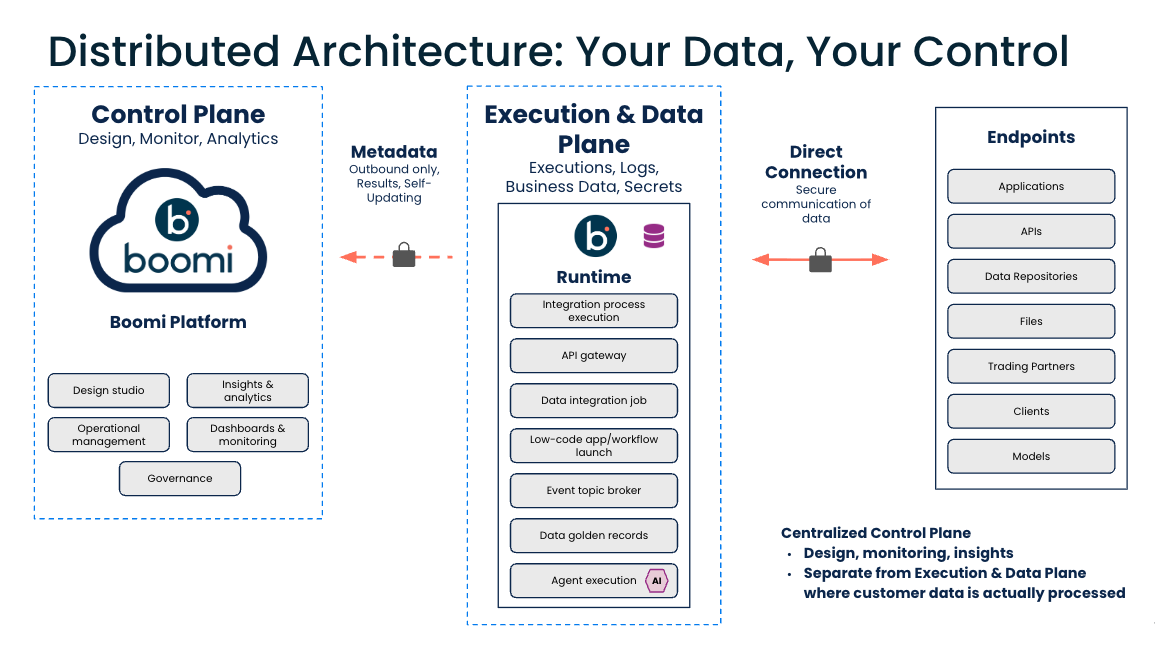
The separation of the control plane and the execution and data plane is one of the core principles and key differentiators of the Boomi platform. This separation allows you to take advantage of the centralized governance of a SaaS design and management console while still providing data residency options to ensure your data and processing only runs where it should.
| Control plane |
|
| Execution & data plane |
|
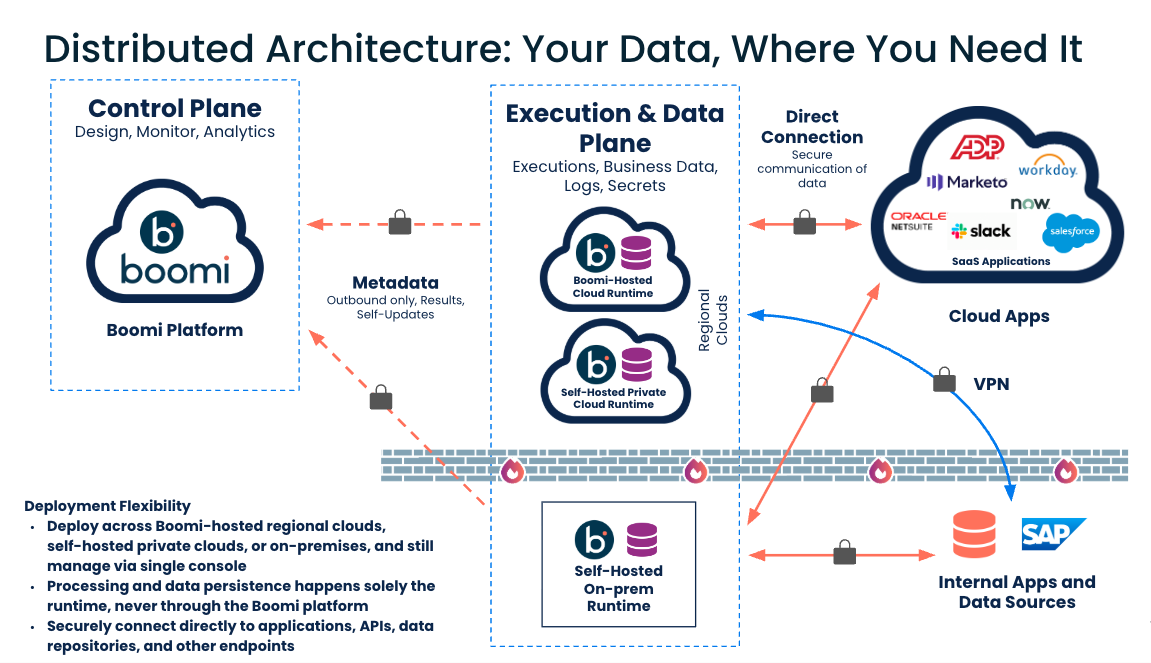
Deployment flexibility
The distributed runtime architecture provides flexibility of deployment options to best meet requirements around geographic location, data residency, network topology, endpoint application access, and customizability.
It is very common to use a combination of runtime deployment options with your account to optimize processing and governance requirements. For example, non-sensitive, cloud application automations can be deployed to a Boomi-hosted cloud runtime to offload hosting responsibilities, while sensitive workloads and integrations requiring access to internal systems can be deployed to a self-hosted runtime within your network.
However, regardless of where your runtime is deployed and who is hosting it, you can view and manage them from the single Boomi platform control plane.
Runtime types
Boomi services runtimes
- Agents- Run AI agents built in Agentstudio.
- API Gateway - Host and govern APIs.
- Cloud API Management (CAM) - Advanced API management and developer portal.
- Data Hub - Store and synchronize golden records.
- Data Integration - Run high-volume ETL and ELT data flows.
- Event Streams - Broker event-based messages.
- Flow - Launch workflows and low-code apps.
- Integration - Execute integration processes.
- Managed File Transfer (MFT) - Transfer files securely.
New cross-platform runtime
- Flex Runtime - A new, containerized runtime designed to provide a consistent install and management experience for one or more Boomi service runtimes or "workloads" within a single cluster. Currently available as Early Access, to support self-hosted Agent deployments at this time.
Hosting options
Depending on the service, you can deploy your assets to a runtime Boomi hosts and manages for you, or to a runtime you install and manage yourself.
- Boomi-hosted - Runtimes fully managed by Boomi. You don't provision or maintain any infrastructure. Most Boomi services offer a range of hosting tiers to accommodate requirements for regionality, volume limits, and reserved capacity. This is a great choice for teams wanting to get started quickly and don't need control over the infrastructure configuration.
- Self-hosted - Runtimes installed and managed by you in the infrastructure of your choice: public cloud (for example, AWS, Azure, GCP), private cloud, or on-premises servers. You choose where they run, giving you full control over infrastructure, configuration, and where your data resides. This is a great choice for workloads with strict data residency and compliance requirements, or when your runtime needs to reach systems within your network.
Hosting options vary by Boomi service. Refer to the runtime types above for details.
Runtime management
For Boomi services runtimes, the creation, configuration, and management of runtimes is available within each respective service. Refer to the runtime types above for details.
A new cross-platform Runtime Management UI is available as Early Access to create and manage Flex runtimes. This management page is planned to provide a consolidated view of all runtime types across the Boomi platform.