Knowledge Hub overview
Refer to the Early Access page to view current programs and request Early Access for a specific feature.
Boomi Knowledge Hub is an AI-ready data service that ingests, organizes, and serves enterprise knowledge to AI agents and applications. It connects your structured and unstructured data to the AI systems that need to reason over it, giving agents accurate, cited responses instead of hallucinated ones.
The problem Knowledge Hub solves
Organizations want to power AI agents with their enterprise data, but that data is scattered across multiple systems. As a result, every query must reconstruct context, leading to unreliable answers, high latency, and rising costs.
- AI agents lack reliable context: Critical data sits in silos across systems, resulting in partial or outdated decisions.
- Retrieval is unreliable at scale: Reconstructing context requires multiple queries, leading to inconsistent results, high latency, and rising operational costs.
- Governance is fragmented and inconsistent: Teams manage access, monitoring, and auditability across separate tools, making consistent control hard to enforce.
Knowledge Hub sits between your enterprise data and your AI agents. It pulls data from your existing sources on a schedule, indexes it for retrieval, and returns relevant, cited chunks to agents at query time without requiring agents to connect directly to each source system.
How Knowledge Hub improves AI agent outcomes
Without a governed context layer, fragmented enterprise data limits AI agents. Knowledge Hub provides trusted context for better retrieval, decision-making, and scalability.
| Capability | Without Knowledge Hub | With Knowledge Hub |
|---|---|---|
| Context | Fragmented, limited to individual systems | Unified across connected sources |
| Reasoning | Based on partial or inconsistent context | Grounded in relevant retrieved context |
| Explainability | Lack of traceability for AI answers and actions | Retrieved sources and policies are traceable |
| Scale and governance | Access and retrieval managed separately by each agent or app | One governed retrieval layer serves all agents and apps |
The three capabilities
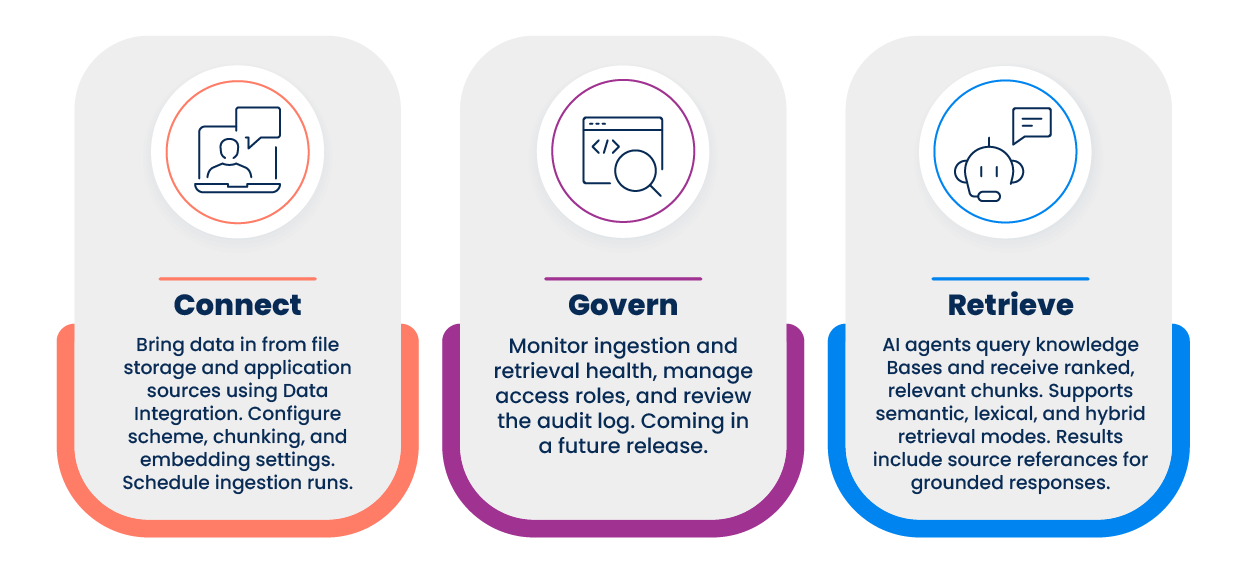
Knowledge Hub has three capabilities.
How Knowledge Hub works
Knowledge Hub processes your data in two phases: ingestion and retrieval.
Ingestion phase
During ingestion, Data Integration extracts content from your source system, splits it into smaller segments called chunks, converts each chunk into a vector embedding, and writes the result to the Knowledge Hub vector store. This process runs on the schedule you configure, so your Knowledge Base stays current as source data changes.

Retrieval phase
At query time, an AI agent sends a natural language query to Knowledge Hub. Knowledge Hub converts the query into a vector using the same embedding model used during ingestion, searches the vector store for the most semantically similar chunks, and returns a ranked list of results with source references. The agent uses these results to generate a grounded, cited response.

Before you start: choose your path
Use the following questions to confirm if Knowledge Hub is the right fit for your scenario.
| Question | Guidance |
|---|---|
| Do your AI agents need to answer questions using your organization's own data? | Knowledge Hub is the right fit. |
| Is your data in a supported source (S3, Confluence, Jira, Salesforce, SAP, GCS, Azure Blob, SFTP)? | Proceed. Refer to Prerequisites for the full connector list. |
| Do you need real-time data access (data that changes by the second)? | Knowledge Hub runs on a schedule. If sub-minute freshness is required, consider a live connector approach instead. |
| Do you need to control which agents can access specific Knowledge Bases? | KB-level permissions are available at GA. In Early Access, all users with a role can access all Knowledge Bases in the account. |
| Do you have an active Data Integration license? | Required. Knowledge Hub uses Data Integration as its ingestion engine. |
Who uses Knowledge Hub?
| Persona | Role | Primary tasks |
|---|---|---|
| Data engineer | Connects data sources and manages ingestion | Creates repositories and Knowledge Bases, configures sources and schedules in Data Integration |
| Administrator | Controls access and platform health | Assigns roles, manages platform configuration |
| AI builder | Builds agents that retrieve enterprise knowledge | Configures retrieval settings, integrates Knowledge Bases into agents via Agentstudio or the API |
Next steps
- Refer to Key concepts to learn the terminology used throughout Knowledge Hub.
- Refer to Prerequisites to confirm your account is ready.
- To set up your first Knowledge Base, refer to Quickstart: ingest your first data source and query it.