NetSuite reporting troubleshooting
Q. Why am I viewing more records than expected from some of my NetSuite entries
The fields (data) you request affect the amount of data retrieved. Some fields have a many-to-many or one-to-many relationship with the main record, and NetSuite returns all that data when queried. If, for example, you request to retrieve only the internalId field, you will get X records from both the API and the NetSuite UI. If you ask for another field with that relationship, you can view X + Y records from both the API and the NetSuite UI. The Employee entity is a good example of this behavior.
Q. Why am I getting Datetime fields when the NetSuite UI shows them as Date fields
The NetSuite UI displays some Datetime values as dates, although NetSuite stores them as Datetime in the background.
The SOAP API returns the dates in their original form as Datetime objects.
For example:
| Date shown in the UI | Datetime when getting the record |
|---|---|
| 21/2/2019 | 2019-02-20T22:00:00.000-08:00 |
| 21/8/2019 | 2019-08-20T22:00:00.000-07:00 |
| 20/2/2019 | 2019-02-20T00:00:00.000-08:00 |
| 21/8/2019 | 2019-08-20T22:00:00.000-07:00 |
When converting back to date fields, remember that NetSuite returns the datetime objects in PST or PDT, depending on the date.
During winter, the Pacific Time Zone is eight hours behind Coordinated.
Universal Time (UTC-8), or Pacific Standard Time (PST). In the summer months, the Pacific Time Zone is seven hours behind Coordinated Universal Time (UTC-7), which is also known as Pacific Daylight Time (PDT).
Q. Why am I missing some fields from my saved search
The SOAP API does not support all fields. To get a list of all relevant fields, consult with the NetSuite Schema Browser.
Search for the Entity and look at the available fields Below you can view an example of some of the fields available for the Account entity:
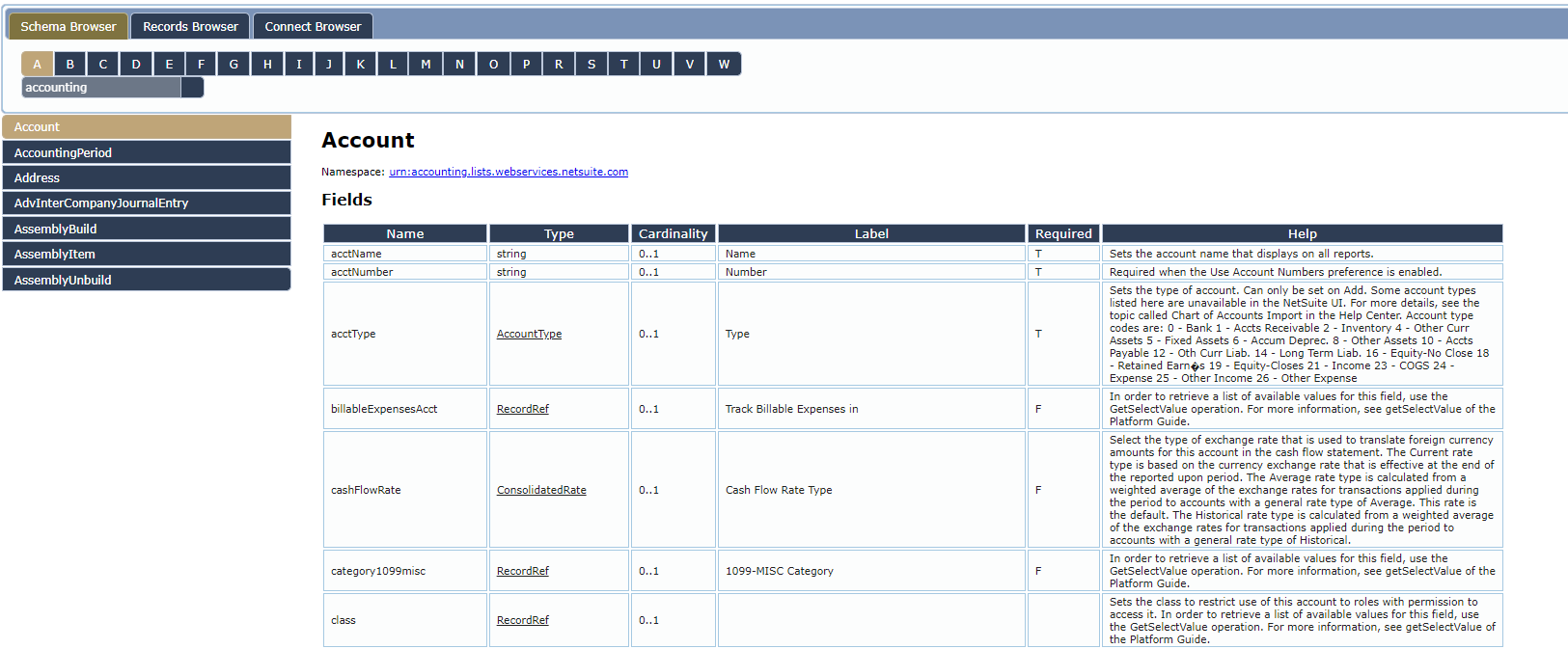
Another possibility is that the field is a custom field with restricted access. Refer to this guide on restricting custom fields and ensuring your role has access.
Q. I am missing some records from my saved search. Why
The SOAP API does not support all records. To get a list of all relevant records, consult with the NetSuite Schema Browser.
Search for the record; if you cannot find it, the SOAP API does not support it.
Another possibility is that NetSuite has not granted your role permission to that record. Follow the steps detailed in the Netsuite Reporting Connection topic to add specific permissions to your desired record.
Q. The data in my fields returns as Camel Cased or with an underscore before the value. Why
A. The SOAP API returns data in this format; it differs from the data the NetSuite connector returns, which connects directly to the database and returns the data in the snake_cased convention.
Q. Why can not I execute Summary Saved Searches
NetSuite API does not support Summary Saved Searches. If you try to execute such a search, you will get the following error from the API: We cannot return search columns for a summary saved search. If you want to execute a saved search via the API, you should do the following and remove the saved search columns: In NetSuite, copy the Saved Search, edit the copied Saved Search, and make sure you define no summary column (max, min, sum) in the Results tab. Set the summary type to blank for all fields.
You can perform aggregations or any other needed transformations in a Logic Flow or over your DB target.
Q. Why can not I find all the entities in the Netsuite Reporting connector
The Netsuite API does not support all entities; the amortization schedule entity is a typical example. To view all supported entities, look at the entities available in the NetSuite Schema Browser. (Make sure you are only under the schema tab) With a few exceptions, Data Integration supports these entities.
Q. Why can not I fetch my saved searches
If you have set everything up correctly in the connection phase, the inherent limitations of the Netsuite API cause this behavior. In cases where there are more than 1000 saved searches for a given entity, the API cannot retrieve them. Enter the saved query internal ID manually. Another alternative would be to clean up unused searches in the NetSuite UI to reduce the number of searches below the limitation.
Q. Why am I only getting IDs and not values for some fields returned from a saved search
The NetSuite API imposes this limitation.
Some fields return only the IntranelId and not the value.
To overcome this, you can create a separate Data Flow to extract the desired entity and create a lookup table.
Then, use a Logic Flow to join the saved search and lookup table data.