API Management Use Cases
Discover how organizations use Boomi API Management to solve real-world integration challenges, streamline developer workflows, and secure their API ecosystem at scale. Review these practical Use cases to see how you can maximize efficiency and get the most out of your APIs.
Explore Boomi Customer Stories to learn more about how organizations have achieved success using the Boomi Enterprise Platform.
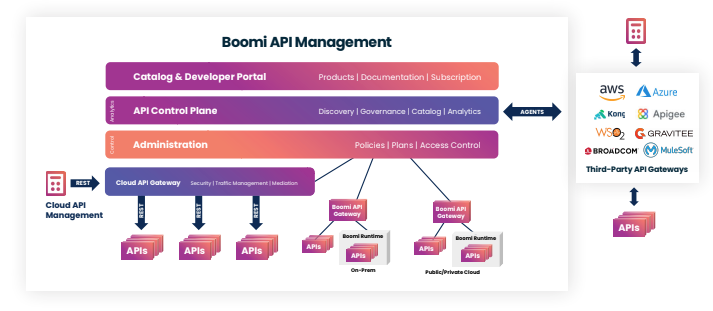
Here are some ways you can use Boomi API Management:
-
Centralize API routing and deployment: Build and manage APIs from a central platform, from design through deployment. Use API Gateway to deploy and securely route APIs built on Boomi Integration, expose legacy or third-party systems as modern REST APIs without touching backend code, and promote API versions across Dev, Test, and Prod environments without breaking existing consumers.
-
Set clear limits on API usage: Apply policy management, including quota and rate limits, to keep backend systems protected under any load.
-
Protect APIs from threats: Apply security and quality scoring, based on industry standards and best practices, including robust authentication mechanisms and fine-grained access control down to the individual method level, to meet compliance needs like ISO 27001, PCI, SOC2, and HITRUST.
-
Discover and govern every API in one place: Automatically discover and catalog APIs across distributed gateways, including "shadow" or "zombie" APIs, into one trusted inventory, governed with a federated approach that doesn't add latency or introduce single points of failure.
-
Centralize Developer Portal access: Utilize one Developer Portal for discovering APIs, registering applications, and requesting access, whether spun up in minutes or fully custom-branded, instead of a separate portal per component.
-
Monitor performance and impact from a single view: Track API performance, usage, adoption, and health in real time, down to geographic and individual-developer activity, and view cache statistics by API and plan to assess the impact of cache parameter changes, to support proactive, data-driven decisions.
-
Design and document APIs faster with AI: Autonomously generate OpenAPI specifications, along with technical and business documentation, from natural language descriptions.
-
Turn APIs into business assets: Manage APIs as products to increase their business value beyond just technical endpoints.
-
Extend governance to AI agents: Curate and expose integrations and APIs as MCP servers with built-in governance, giving AI agents secure, controlled access to enterprise systems.
Use cases
Modernizing dealer and supplier API access
A global manufacturer of aerial work platforms and materials processing equipment grew substantially over several years, both organically and through acquisitions. That growth strained the point-to-point integrations connecting the company's business systems to its Oracle eBusiness Suite (EBS), the central system running its core operations. Every new dealer, partner, or supplier that needed to exchange data with the company required a custom-built connection. As its footprint expanded, this one-off approach became increasingly costly and slow to scale, while also making it harder to enforce consistent security and access controls across a growing base of external consumers.
To address this, the company adopted an API-first integration strategy built on Boomi to turn core business processes into reusable, governed APIs, rather than continuing to build one-off integrations for each new relationship. It started with its order-creation process, exposing it as a single API that any client application (dealer portal, mobile app, or partner system) could call, replacing a separate point-to-point build for each consumer. The company extended the same approach to a dealer-facing capability that automatically notifies dealers when a customer's equipment needs maintenance, again exposing it as a reusable API rather than a dedicated integration per dealer. As more business-critical processes moved behind APIs, the company relied on API Gateway specifically to handle the resulting high transaction volumes reliably, while using Boomi API Management more broadly to authenticate a growing number of dealers, partners, and internal systems in an industry-standard, scalable way.
With this approach in place, the company:
-
Eliminated one-off integrations: No longer needed to build a new point-to-point integration every time a dealer, partner, or supplier needed access to a business process.
-
Onboarded new consumers faster: New dealers, partners, and suppliers connect against existing, reusable APIs instead of requiring custom development.
-
Gained consistent authentication at scale via Boomi API Management: A uniform way to authenticate and secure access as its API footprint grew alongside acquisitions and organic growth.
Accelerating university grant access with APIs
A large university periodically evaluates academic and student data stored in its ERP system to determine eligibility for annual grants. This data is spread across more than 20 campuses, and was manually gathered, sent via FTP to the university, and manually analyzed. As a result, it took weeks to determine eligibility.
The university looked into modernizing its ERP system, but determined that the cost and time to accomplish this were blockers.
Using Boomi’s API Management solution, APIs and integrations were built across all campuses, standardizing and accelerating communication.
These APIs dramatically reduced the time required to send data from the ERP system to the university, reducing it from at least a month to days. It also reduced the manual IT work, and students are notified about grant eligibility much sooner.
Simplifying data onboarding
A children's charity organization, dedicated to funding medical research and providing family-centered care for seriously ill children, relied on a growing network of partner fundraising agencies to bring in donor and income data. Every time the organization onboarded a new agency, it had to build a custom, one-off data integration process to accommodate that agency's specific data formats and submission channels. As the partner network grew, maintaining a separate integration process for each agency became increasingly expensive. Processing logic and data profiles differed by agency, and the systems were tightly coupled to the organization's Salesforce implementation, so a change to a single staging object required updates across multiple, separately built integration processes. As a result, onboarding a new agency took a significant amount of time before it was fully operational.
Working with a Boomi implementation partner, the organization replaced its per-agency custom builds with two standardized, reusable APIs (a Supporter API for donor and supporter information, and an Income API for donation and limited supporter data), deployed behind a Boomi API Gateway paired with a Developer Portal. Each partner agency is onboarded through Azure AD and issued its own authenticated API key. Agencies subscribe to the APIs they need and get access without a dedicated integration being built for them. API Gateway validates every incoming request, ensuring only authorized, properly authenticated traffic reaches the organization's systems. Behind the API layer, the organization replaced its hardcoded, per-agency logic with a category-driven, cross-reference-table approach. Incoming data is now automatically routed to the correct action, such as insert or update, based on its category rather than agency-specific rules. Built-in logic also auto-populates fields that agencies can't supply themselves, keeping each agency's required payload to a minimum.
As a result, the organization:
-
Reduced agency onboarding time by roughly 70%: New partner agencies are onboarded significantly faster than under the old one-off integration model.
-
Improved data consistency: Standardizing on a common API contract improved the consistency of data submitted across the partner network.
-
Simplified ongoing maintenance: New agencies onboard using the existing reusable APIs and editable cross-reference tables rather than a new custom build each time.
-
Strengthened access security: Separate keys, client credentials, and expiration controls are maintained per agency and per environment.
-
Lowered development costs: Eliminated the need for repeated custom integration, reducing ongoing development costs.
Launching fast, safe, and reliable API solutions
A mid-sized digital-first financial services company needed a secure, fast-to-market API management solution to meet growing demand for real-time financial data access via mobile apps and partner platforms. The company aimed to launch a secure, compliant API platform for fintech partners and developers within three months. With limited IT resources and no in-house API gateway expertise, they required a cost-effective solution for moderate traffic.
To meet their goals quickly and securely, the company partnered with Cloud API Management, which provides an intuitive interface for managing APIs throughout their lifecycle. This partnership enabled them to:
-
Enhance security: Securely connect with partners using built-in caller authentication and encrypted data transfer.
-
Optimize traffic: Manage traffic and maintain performance during peak usage with smart throttling policies.
-
Accelerate deployment: Deploy quickly without internal infrastructure buildup to ensure smooth, always-on API performance.
Real-time API visibility and control for APIs
A large nationwide departmental store chain relies on APIs to distribute fresh fruits from third-party vendors. Their IT team faces security and functionality issues with their current API system and is seeking solutions to improve security, traffic monitoring, and the Developer Portal.
To meet their goals quickly and securely, the company partnered with Cloud API Management - a platform offering an intuitive interface for managing APIs throughout their entire lifecycle. This partnership enabled them to:
-
Enhance security: Leveraging Cloud API Management, developers can build secure APIs that follow best practices in API design and management.
-
Improved API Management and monitoring: Developers can easily configure, deploy, and monitor APIs, enabling proactive issue resolution and performance optimization based on real-time analytics.
-
Real-time data access: With advanced management tools, Cloud API Management promotes an agile API development environment, fostering collaboration across teams and ensuring APIs align consistently with business objectives.
Secure, scalable, and cost-effective API solution
A company faced challenges managing APIs securely and efficiently as their business grew. Their developers needed a reliable platform to integrate applications with products while protecting APIs from unauthorized access. They required a cost-effective solution that could easily handle both internal and external API traffic.
The company needed an API Management solution to secure access for teams and partners, handle traffic smoothly, make it easy for developers to connect apps, scale with business growth, and maintain fair, predictable costs.
With Cloud API Management, the company has achieved:
-
Secure API deployment: Enhanced security with built-in authorization controls, keeping their APIs safe.
-
Traffic management: Efficient routing to handle traffic smoothly across all our applications.
-
Simplified Developer Portal: A comprehensive platform that speeds up and simplifies app integration.
-
Scalable solution: Scalability to support our growing organization, whether APIs are used internally or externally.
-
Cost-effective pricing: Transparent, fair pricing that offers great value with predictable costs.